
What Is a Vehicle Equivalency Analysis (and Why Does Your Fleet Need One)?
Knowing how many maintenance technicians your shop actually needs is harder than it sounds. A fleet of 300 vehicles is not just 300 units of equal work. A sedan and a refuse truck might both show up as “one vehicle” on a spreadsheet, but the maintenance hours they demand are vastly different.
A Vehicle Equivalency Analysis (VEA) solves this problem. It is a structured method for converting a diverse fleet into a common unit of measurement called the Vehicle Equivalency Unit (VEU), making it possible to calculate total maintenance demand and, from there, determine appropriate staffing levels. The methodology is based on NAFA Fleet Management Association recommendations and is widely used as an industry standard across government, public safety, and enterprise fleet operations.
If you manage a mixed fleet and you have ever struggled to justify a new hire or defend your team size to leadership, a Vehicle Equivalency Analysis is the report that turns that conversation into a data-backed discussion.
Understanding Vehicle Equivalency Units (VEUs)
The VEU is the core building block of the analysis. Every vehicle or piece of equipment in your fleet is assigned a VEU value that reflects its maintenance complexity relative to a baseline vehicle, typically a passenger car or mid-size sedan.
A sedan starts at a VEU of 1.0. Industry benchmarks place a standard half-ton pickup at roughly 1.5 VEUs, while larger and more complex assets (street sweepers, dump trucks, refuse trucks, fire trucks) carry significantly higher values. The heavier and more complex the asset, the more maintenance hours it demands relative to that baseline, and the higher its VEU.
Once every asset class has a VEU value assigned, you multiply the number of vehicles in each class by their VEU value and add everything up. The result is the total VEU count for your fleet, which reflects the true maintenance workload regardless of how many individual vehicles are on the roster.
Baseline: passenger sedan = 1.0 VEU
Raw vehicle count understates your actual workload.
To find a fleet’s total VEUs, you multiply the VEU value for each vehicle type by the number of that type in your fleet. A fleet with 200 sedans and 15 refuse trucks looks like 215 vehicles on paper. But 200 sedans × 1.0 = 200 VEUs, while just 15 refuse trucks × 12.0 = 180 VEUs. Those 15 trucks generate almost as much maintenance demand as the entire sedan fleet combined. Staffing to vehicle count rather than VEUs means your shop is almost always understaffed.
From VEUs to Technician Headcount: How the Math Works
Total VEUs tell you the scale of the work. From there, the analysis translates that number into a technician count using a standard benchmark.
Each VEU represents approximately 6 to 10 maintenance hours per year, depending on fleet age, operating environment, and parts support availability. The total VEU count multiplied by the applicable hours-per-VEU figure gives you the total annual maintenance hours your shop needs to support.
That number is then divided by the productive hours available from a single technician. NAFA’s benchmark for productive time is 1,415 hours per year (or 118 hours per month), accounting for vacation, sick time, training, parts waiting, and other non-productive time drawn from a standard 2,080-hour work year. The result is the number of full-time equivalent technicians your fleet mathematically requires.
For example, a fleet of 300 vehicles might calculate out to 825 vehicle equivalents. At 6 hours per VEU, that is roughly 4,950 maintenance man-hours needed annually, pointing to approximately three to four technicians depending on workload distribution.
Vehicles vs. VEs
What the Report Reveals Beyond Headcount
Staffing levels are just the starting point. A well-run Vehicle Equivalency Analysis also surfaces important information about the composition of your maintenance team.
Specialty technician needs: If your VEU breakdown shows that a significant portion of your fleet consists of heavy-duty equipment with high MRF values (Maintenance Repair Factor), you may find that your shop needs more technicians with diesel, hydraulic, or air brake training. Light-vehicle technicians are not interchangeable with heavy-equipment technicians, and the VEA helps you see where the imbalance is.
Seasonal staffing patterns: Running the analysis monthly (using the 118-hour monthly benchmark) gives fleet managers a clearer view of when demand spikes throughout the year, helping plan for temporary or contract staffing during peak periods rather than overstaffing year-round.
Outsourcing benchmarks: Once you know your total maintenance hours required, you can factor in a realistic outsourcing assumption and arrive at a net staffing number that reflects how your shop actually operates. If a shop is outsourcing more than 25%, it may be understaffed. If it is outsourcing significantly less, it may be overstaffed.
Fleet complexity scoring: Comparing VEU totals over time gives managers a meaningful way to track whether the fleet is growing more complex or simpler to maintain, separate from raw vehicle count.
Our Vehicle Equivalency Staffing Calculator
Knowing your VEU total is one thing. Seeing what it means for your staffing is another. Enter your fleet mix below, and the calculator will apply the NAFA-standard benchmarks to give you an estimated technician headcount based on your actual maintenance demand.
Vehicle Equivalency Analysis — Staffing Calculator
Enter your fleet mix to calculate estimated technician headcount
| Vehicle type | VEU value | Vehicle count | Total VEUs |
|---|
Raw vehicle count understates your actual workload.
Running a Vehicle Equivalency Analysis in Collective Data
Collective Data’s fleet management platform includes a built-in Vehicle Equivalency Analysis report, built around the industry-standard NAFA calculations. The report uses the recommended benchmarks of 1,415 hours per year or 118 hours per month as the default technician productivity baseline, and both figures are configurable to match your organization’s specific standards if needed.
Because Collective Data centralizes all maintenance history, labor time, and work order data in one place, the VEA report draws on your actual shop data rather than estimates. Every hour a technician logs against a work order feeds into the calculations, which means the report reflects what is actually happening in your facility over the defined time period.
Fleet managers can use the report to:
- Justify staffing changes with documented, data-backed calculations
- Identify vehicle classes that are disproportionately driving maintenance hours
- Benchmark current technician workloads against NAFA productivity standards
- Present leadership with a clear, standardized picture of shop demand
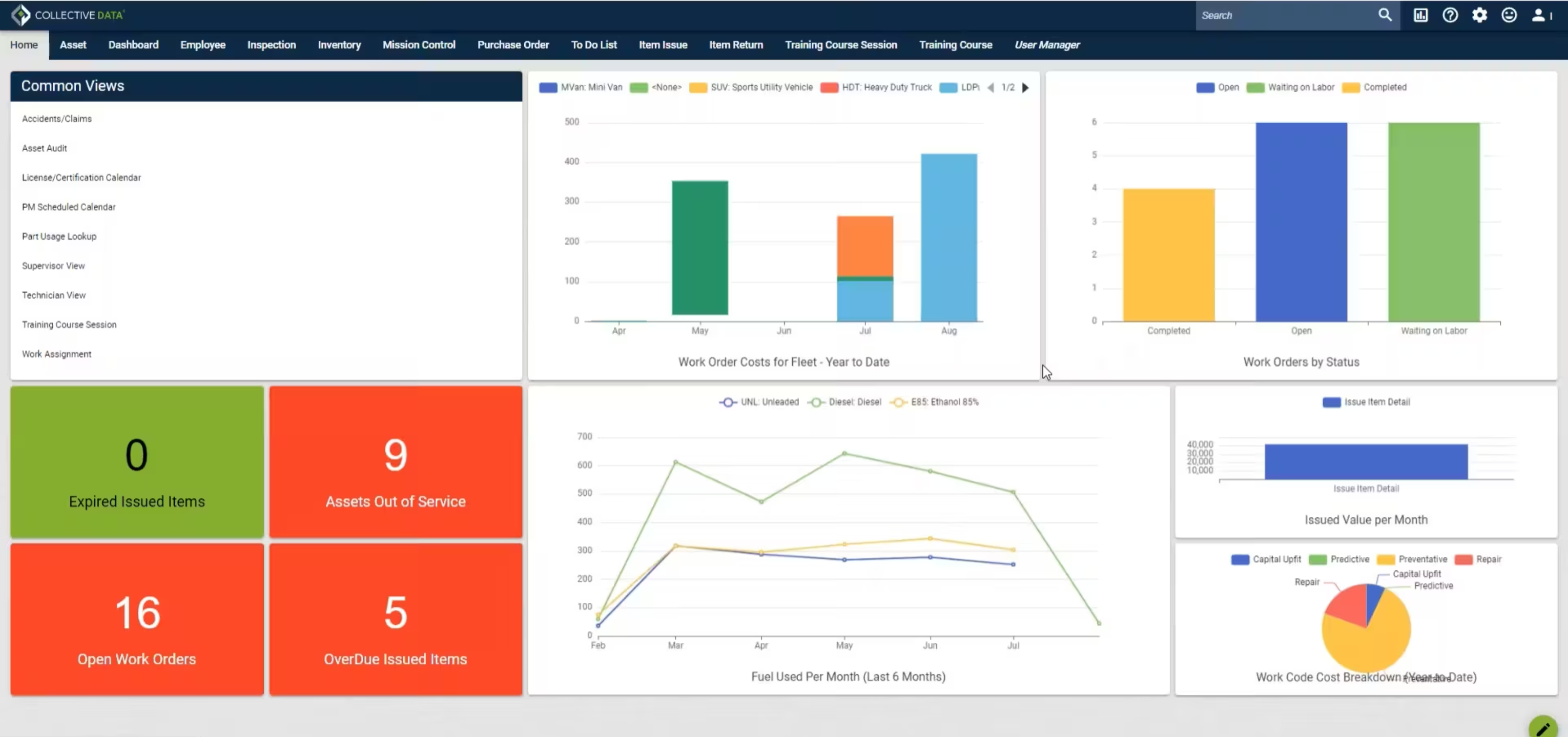
The report is part of Collective Data’s broader reporting and dashboards capability, which allows managers to schedule recurring exports, customize outputs, and build the specific views that match how their organization measures performance.
Putting It to Work
A Vehicle Equivalency Analysis is most valuable when it is run consistently rather than as a one-time exercise. Fleets change, vehicles age, and maintenance complexity shifts. Managers who run the VEA on a regular schedule build a historical record that makes it easier to spot trends, plan ahead, and make the case for resources before a staffing gap becomes a problem.
If your shop is running lean and you have been meaning to find a defensible way to quantify the workload, this report is a practical place to start.
To see how the Vehicle Equivalency Analysis works inside Collective Data, schedule a demo with our team.